
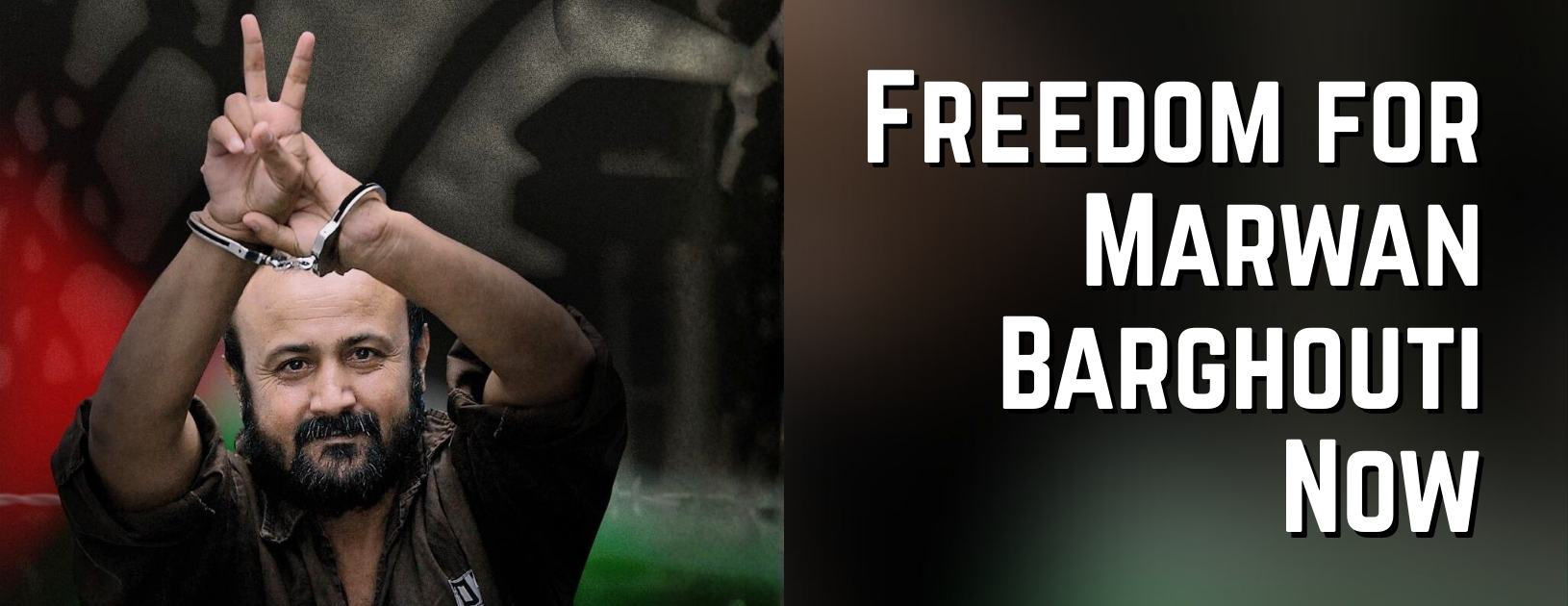
Marwan Barghouti is often described as Palestine’s Nelson Mandela. Like Mandela, he has been unjustly imprisoned for resisting oppression and fighting for the rights of his people. He has spent over 23 years in prison following a trial widely condemned by international observers for failing to meet basic standards of due process. Human rights organisations around the world have raised serious concerns about his torture in Israeli prisons and his deteriorating health.
Barghouti’s continued detention by Israel is seen as a major obstacle to reconciliation and a credible peace process. He commands broad support across Palestinian society and has consistently advocated for unity and democratic reform.
If Australia is serious about its recognition of the State of Palestine, it must call upon Israel to immediately and unconditionally release Marwan Barghouti.
We must pressure all members of Parliament to advocate for Barghouti’s freedom and for the immediate release of all Palestinian political prisoners.
Take action now: Email your MP with our template
Marwan Barghouti's Story
Palestine's Most Respected Leader
Marwan Barghouti is a leading advocate for Palestinian justice and self-determination. He is Palestine's most respected and trusted politician – polls have shown he is the most popular Palestinian politician who will unite Palestine as its next President.
Barghouti has been named the most important political prisoner held by Israel.
He has been languishing in an Israeli jail for more than 23 years after an illegitimate and deeply flawed trial set up to silence him. He has spent long periods in solitary confinement and has suffered physical and psychological torture on numerous occasions.
Just as national leaders Nelson Mandela and Xanana Gusmão were imprisoned for fighting for their people's freedom and human rights, so too has Marwan Barghouti.
Early Life and Political Rise
Born in 1959 in the West Bank village of Kobar, Barghouti grew up against the backdrop of the 1967 illegal Israeli occupation, becoming active as a teenager in student politics and grassroots organising. As a young man he joined Fatah, the principal Palestinian nationalist movement, and his involvement soon led to his first arrest in 1978. He spent more than four years in Israeli prison, an experience that strengthened rather than diminished his commitment to justice and political activism.
After his release, Barghouti studied at Birzeit University, where he quickly became a prominent figure in the student leadership. He helped organise campus political activity, worked to mobilise Palestinian youth, and developed a broad base of support among young activists.
When the First Intifada erupted in 1987, Israel deported him to Jordan, but his political work continued in exile as he maintained close ties with Fatah's leadership and contributed to shaping the movement's direction.
Barghouti returned to the West Bank after the signing of the Oslo Accords in the early 1990s, stepping directly into a growing leadership role. In 1994, he became Secretary-General of Fatah in the West Bank and later helped establish the Tanzim, a grassroots faction created to engage younger Palestinians and strengthen Fatah from within. His influence continued to rise as he became known for calling for internal reform, speaking out against corruption and promoting a more representative political system.
In 1996, Barghouti was elected to the Palestinian Legislative Council as part of the new Palestinian Authority's political institutions. By this stage, he had become one of the most recognisable leaders of his generation, capable of bridging generational and political divides within Palestinian society. He spoke persuasively, in Hebrew and Arabic, about negotiations and political solutions, and advocated for a political resolution grounded in international law and the rights of Palestinians to self-determination.
Arrest, Trial and Ongoing Imprisonment
In 2002, during the Second Intifada, Israeli forces arrested Barghouti in Ramallah, during one of the largest Israeli military attacks in the West Bank since 1967. He was transferred to Israel, a move that immediately drew international criticism for violating the Fourth Geneva Convention, which prohibits the transfer of people from occupied territory. Once in Tel Aviv, Barghouti was interrogated under conditions that his lawyers and family reported involved torture, prolonged isolation and limited access to legal counsel. His arrest marked the beginning of a prolonged period of imprisonment that has now lasted more than two decades.
It is important to acknowledge that Barghouti was arrested for exercising his right under the United Nations charter to resist an illegal occupation of Palestine. Nelson Mandela was jailed for resisting an illegal Apartheid regime and Xanana Gusmão was jailed for resisting the illegal Indonesian occupation of East Timor. Both represented their people's aspirations and after long periods in jail became highly respected leaders of their country. A similar destiny awaits Marwan Barghouti upon his release.
From the outset, serious concerns were raised about the conditions surrounding his detention and the fairness of the legal process. Barghouti was tried by an Israeli civilian court in proceedings that numerous international observers later concluded fell far short of basic standards of due process. Barghouti refused to recognise the illegal court proceedings and has always maintained his innocence.
Parliamentary bodies and legal organisations highlighted multiple irregularities, including restrictions on his ability to communicate confidentially with his lawyers, limits on presenting a full defence, and the use of evidence that was widely questioned. The political climate surrounding the trial, with public statements from senior Israeli officials prejudging his guilt, further undermined the integrity of the process.
Barghouti rightly rejected the legitimacy of the court, insisting that as a representative of a people living under occupation, he should be dealt with in accordance with international law, not prosecuted in the domestic courts of the occupying power. His conviction and sentencing are illegitimate and were followed by years of harsh imprisonment, including extended periods in solitary confinement and significant restrictions on family visits. More recently he has been tortured on multiple occasions.
Despite his imprisonment, Barghouti has continued to play a central role in Palestinian political life. From prison he contributed to negotiations, supported calls for political unity, and co-authored the 2006 "Prisoners' Document", which set out a path toward national reconciliation. His continued influence reflects the broad support he holds across Palestinian society, and the belief shared by many analysts that his involvement is essential for any credible peace process.
Immediate Threats to His Life
Israel has banned the International Red Cross from seeing Barghouti, in breach of international law, and the Palestinian Prisoners' Club has expressed grave concerns for his life.
On 14 September 2025, Barghouti was beaten unconscious by eight Israeli guards, breaking four ribs. This was his fourth assault in two years.
UN Special Rapporteur Francesca Albanese fears for his life. Israeli Minister Ben-Gvir has publicly threatened him with execution.
His family fears Barghouti will be killed if he is not immediately released.
Why Australia Must Act
As Australia has now recognised the State of Palestine and reaffirmed its commitment to a peaceful, negotiated resolution to the conflict, Barghouti's case is no longer a distant issue. The injustice of his imprisonment, the repeated concerns raised by international legal bodies, and his role as one of the most widely supported Palestinian leaders makes his situation directly relevant to Australia's stated principles: respect for international law, support for human rights and the pursuit of a durable peace.
The Inter-Parliamentary Union, representing over 180 national parliaments, found "numerous breaches of international law" and concluded Barghouti did not receive a fair trial.
The Elders, founded by Nelson Mandela, and Nobel laureates including Archbishop Desmond Tutu, President Jimmy Carter, and José Ramos-Horta, have called for his release.
Amnesty International, Human Rights Watch, and multiple UN bodies have repeatedly raised concerns about his treatment and deteriorating health.
As Mandela said: "What is happening to Barghouti is exactly the same as what happened to me."
And as Mandela also reminded us: "To deny people their human rights is to challenge their very humanity."
Standing for justice in Barghouti's case aligns with Australia's commitment to peace and human rights.
Join the Campaign
Write to Your MP and Senators
Urge your Federal MP and Senators to:
- Raise in Parliament the urgency of Barghouti's unconditional release
- Urge the Government to advocate for his freedom and independent monitoring of his health and prison conditions
- Call for the immediate release of all prisoners held without charge and all political prisoners
Other Ways to Support
- Learn more: Visit the global Free Marwan campaign led by his family
- Watch: Tomorrow's Freedom – a documentary filmed over five years with intimate access to Marwan's family and colleagues (available on streaming services)
- Share: Spread awareness on social media using #FreeMarwan #MarwanBarghouti
- Attend: Join upcoming events demanding the release of Marwan Barghouti and all Palestinian political prisoners
Resources & Further Reading
Campaign Materials
Recent News & Statements
- The Guardian (29 Nov 2025): Free Marwan Barghouti global campaign
- Yanis Varoufakis on Marwan Barghouti
- 200+ cultural figures call for release – including Sting and Paul Simon
- Francesca Albanese fears for his life (16 Oct 2025)
- September 2025 beating details
- Al Jazeera: Family fears for his life
- Ben-Gvir August 2025 video threat
International Recognition
- Robben Island Declaration – including Archbishop Desmond Tutu
Palestinian Human Rights Organisations
- Addameer – Palestinian Prisoner Support
- Al-Haq – Palestinian Human Rights Organisation
- Palestine Solidarity Campaign – Prisoners
"There can be no real peace without justice, and no justice without freedom."
— Marwan Barghouti
"Freedom is indivisible; the chains on any one of us are the chains on all of us."
— Nelson Mandela